Acne Control and Acne Accuracies
Acne is the eruption of lesions on various parts of your body. You could have acne on your face, on your chest, on your back, on your neck, on your shoulders, and even on the upper part of your arms. These acne lesions might appear as blackheads, whiteheads, nodules or cysts. Most people get acne in their teen years.
Some get it in their forties. Acne isn't going to threaten your life, of course, but it could seriously interfere with it, especially if it disfigures you for the rest of your life. Acne doesn't have to be severe to cause disfigurement.
The onset of puberty brings hormonal changes to our bodies and these changes can cause acne. Oil glands, called sebaceous glands because they secrete sebum (oil) are now working more than they were during your childhood before puberty.
Androgens, male hormones, are the primary culprit for this abundant secretion. Girls and women have androgens, though they don't have as many as boys and men.
A hair follicle starts the acne ball rolling. This sebaceous follicle, inside the sebaceous gland, is where acne happens. Puberty gets skin lining cells shedding more than in childhood but when they stick together as they sometimes do the extra oil results in a clogged pore. The oil builds up in this pore but can't get out. The follicle swells up and you have a lesion.
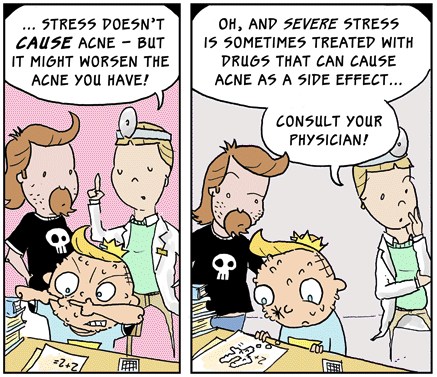 |
| Myth- Stress Cause Acne |
P. acne, a bacterium present in your skin starts to multiply to excess because of the clogging in the follicle. Your skin is now irritated and probably inflamed.
Should the follicle burst at this point the skin around the follicle is going to react too. You are now going to have nodules, blackheads and/or pimples elsewhere on your skin. You now have acne lesions.
There are myths about acne that have been around for a long time that give you false information about acne. Let's dispel those myths right now. One of the more common of the false ideas you could have about acne is that if your hygiene is poor you're going to get acne. While you may very well get acne that poor hygiene is not the cause.
Believing that could make your acne ever so much worse as you harshly scrub your poor face into irritation. Of course you don't want excess oil and dirt from the day's ventures sitting on your face, but when you wash it away be gentle.
Only wash your face twice each day, and do so gently. Drying should be patting gently instead of vigorously. If you still have acne try something at the pharmacy that says it treats acne or visit a dermatologist.
Stress doesn't affect or cause acne. This is a myth and it's not true. The stress you encounter throughout the day isn't going to bring on acne. Even were you to have stress beyond normal levels and take medication prescribed by your doctor that level of stress still isn't going to cause acne. The medication might, however, and if it does, tell your physician.
Let's also dispel the myth that the food that you consume affects your acne. Nothing could be further from the truth. Yes, do get a healthy balanced diet but don't think it's going to clear up your acne or prevent it from occurring. It won't.
Don't listen to those people who pooh pooh your acne complaints with comments about it only being cosmetic. As a teen especially, there is no "only" to cosmetic flaws. It's a self-esteem issue, and it could be that permanently if that acne gets bad enough and exists long enough to scar you forever.
Summary:
Acne is the eruption of lesions on various parts of your body. You could have acne on your face, on your chest, on your back, on your neck, on your shoulders, and even on the upper part of your arms. These acne lesions might appear as blackheads, whiteheads, nodules or cysts. Most people get acne in their teen years. Some get it in their forties. Acne isn't going to threaten your life, of course, but it could seriously interfere with it, especially if it disfigures you.


